hupsim
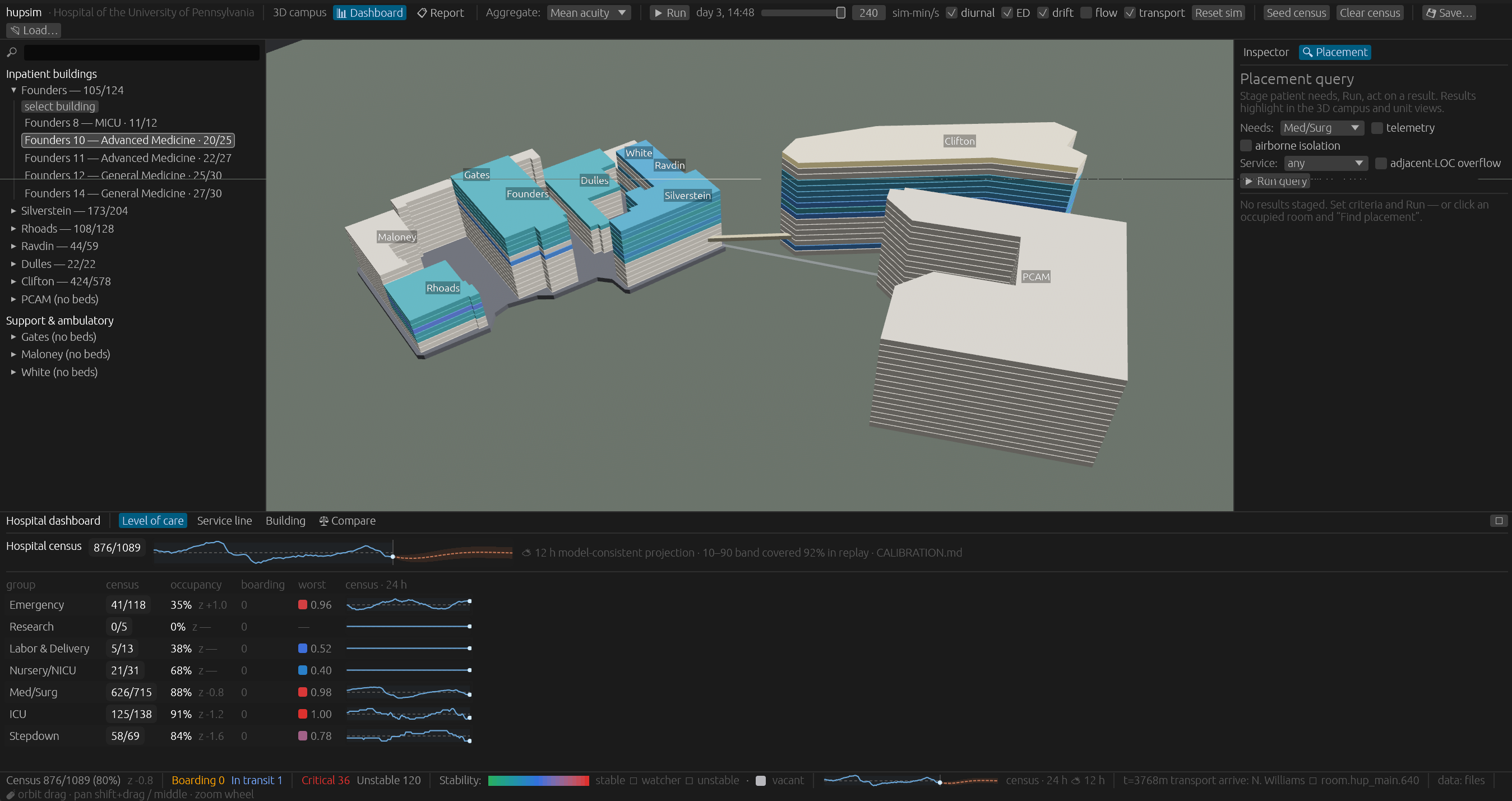
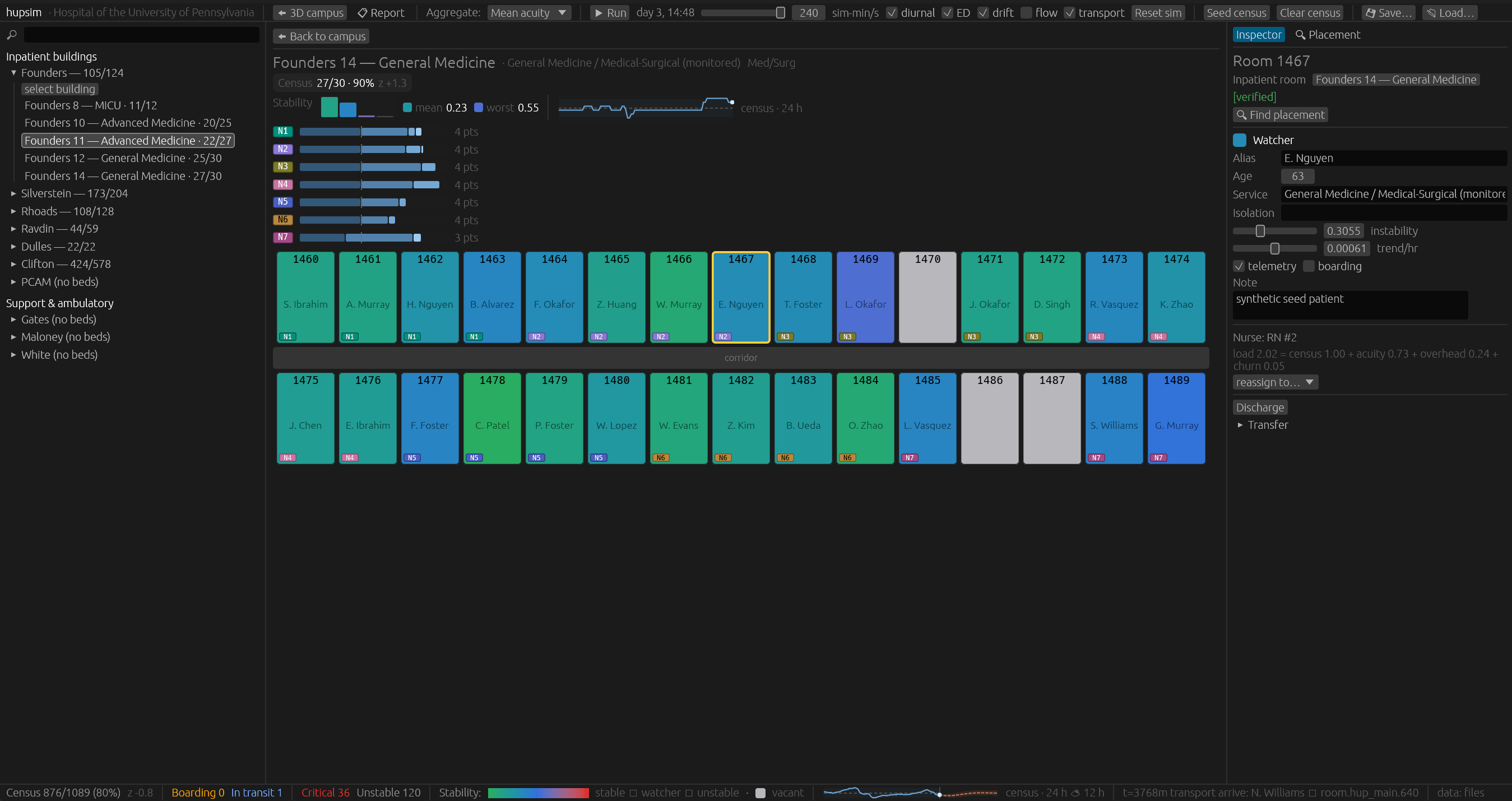
V1 (demo) shippedA room-level capacity model of a single academic hospital campus, built entirely from cited public sources with a confidence tag on every structural fact and all dynamics explicitly simulated.
Curriculum Vitae, Narrative, & Portfolio
Acute Care Hospitalist — ABIM-Certified, PA-Licensed Data Scientist & Engineer
I am a board-certified internist and acute care hospitalist driven by a well-known engineering maxim: “all models are wrong, but some are useful.” After engineering and medical school at Texas A&M and internal medicine residency in Dallas, I spent two years on the McGovern Medical School faculty, practicing at Memorial Hermann Hospital–Texas Medical Center. I concluded that appointment in the spring of 2026 to relocate to Philadelphia with my fiancée; now licensed in Pennsylvania, I continue public and private data work while seeking a clinical home in which to combine inpatient care, teaching, and responsible technical work.
My foundation is high-volume, high-acuity inpatient medicine in a hospitalist group responsible for more than 40% of the institutional admissions, on service lines spanning oncology, neurology, transplant, geriatrics, and trauma. My group’s triage and capacity-management duties entailed ED- and ICU-facing acuity forecasting, level-of-care decision-making, and transfer requests from outside institutions. My teaching roles included: supervising residents and delivering triage lectures for incoming interns, disease-management lectures for surgical residents, and medication reconciliation lectures during safe-discharge workshops.
Pilot deployments of Viz.ai, Ambiance, and Regard at my prior institution left me unwilling to dismiss AI tools or accept it casually. These tools remain under-acknowledged risk surfaces, so I strictly define risk by what software may read and what its output may induce. The projects listed on this page are, to date, built and maintained myself in Python, SQL, and Bash. They hold to that same standard: only mimicwarehouse faces de-identified patient data, kept local and redundantly inaccessible to agents, while other clinically adjacent prototypes run on synthetic or fictional inputs. Attending physicians must adopt these tools early and earnestly enough to catalog their hazards and to lobby for privacy and quality before profit. Ultimately, I believe the core essence of modern medicine remains at the bedside.
Hospitalist, Acute Care (Internal) Medicine
Memorial Hermann Hospital–Texas Medical Center, Houston, TX
Assistant Professor of Emergency Medicine, Hospitalist Division
McGovern Medical School at UTHealth, Houston, TX
Internal Medicine Internship & Residency
Texas Health Presbyterian Hospital, Dallas, TX
Doctor of Medicine
Texas A&M College of Medicine, College Station, TX
Bachelor of Science in Biomedical Engineering, cum laude
Texas A&M University, College Station, TX
Pilot User & Edge-Case Tester, Hospitalist Cohort
Regard AI EHR Copilot Implementation Team
Clinical Beta Tester, Hospitalist Cohort
Ambiance AI Scribe Beta Utilization Team
Epic SlicerDicer & Inter-Operability Analyst
Capacity Management Dashboard Analytics Task Force
Viability Analyst & Hospitalist Cohort Representative
Viz.AI Aortic Dissection Classifier Implementation Team
Active Member & Root-Cause Analyst
Hospitalist Division Quality Assurance Committee
A room-level capacity model of a single academic hospital campus, built entirely from cited public sources with a confidence tag on every structural fact and all dynamics explicitly simulated.
A local EMR data warehouse over MIMIC-IV with end-to-end provenance, protocol-frozen inquiry over retrospective data, and a pre-commit leak guard — data never leaves the machine.
57 of 172 session briefs · as of September 2026
A medication reconciliation simulator for students, residents, and fellows — a resident-facing example of what physician-driven software design can produce, on wholly synthetic inputs.
12 of 39 session briefs · as of September 2026
Measuring census-tract access to health-relevant community resources across Philadelphia, with uncertainty shown beside every result — it measures access; it does not model outcomes.
18 of ≈ 40 work packets · as of September 2026
A structured synthesis of existential psychotherapy literature for physicians and patients — corpus work applied to the parts of clinical life that resist quantification.
Modeling editorial coverage gaps in WikEM, the open emergency medicine reference — where the clinical knowledge commons is thin, and whom that thinness reaches.
A decade of personal game records as a longitudinal backbone for cross-analysis — a controlled sandbox for time-series and behavioral methods before they meet clinical data.
Some private work involves data that cannot be redistributed; the rest is simply unfinished. Neither is listed here as a placeholder for something that does not exist — ask, and I will walk you through any of it.
Python, SQL, Bash
DuckDB, Parquet, Polars, pandas, reproducible pipelines, provenance & disclosure discipline
MIMIC-IV, Epic SlicerDicer, ICD-10 terminology, de-identification, risk stratification & medication reconciliation heuristics
Discrete-event & capacity simulation, geospatial analysis, Streamlit, Git-based version control